
Best AI Testing Tools in 2026: 10 Reviewed by What the AI Actually Does
Ten AI testing tools reviewed by what the AI actually does: agentic platforms, IDE copilots, visual AI, and AI-enhanced frameworks. Honest reviews from practitioners.
- Written by
- Yuvan Sundrani
- Read time
- 16 min read
- Published

The label "AI testing tool" covers four products that have almost nothing in common. An agentic platform that generates and maintains your entire regression suite from a plain-English description is a different product from an IDE copilot that autocompletes your test function. And both are different from a visual AI tool comparing screenshots or a cloud platform running your tests on 3,500 real devices. This guide reviews ten tools grouped by what the AI actually does, with honest takes on where each one falls short.
Key Takeaways
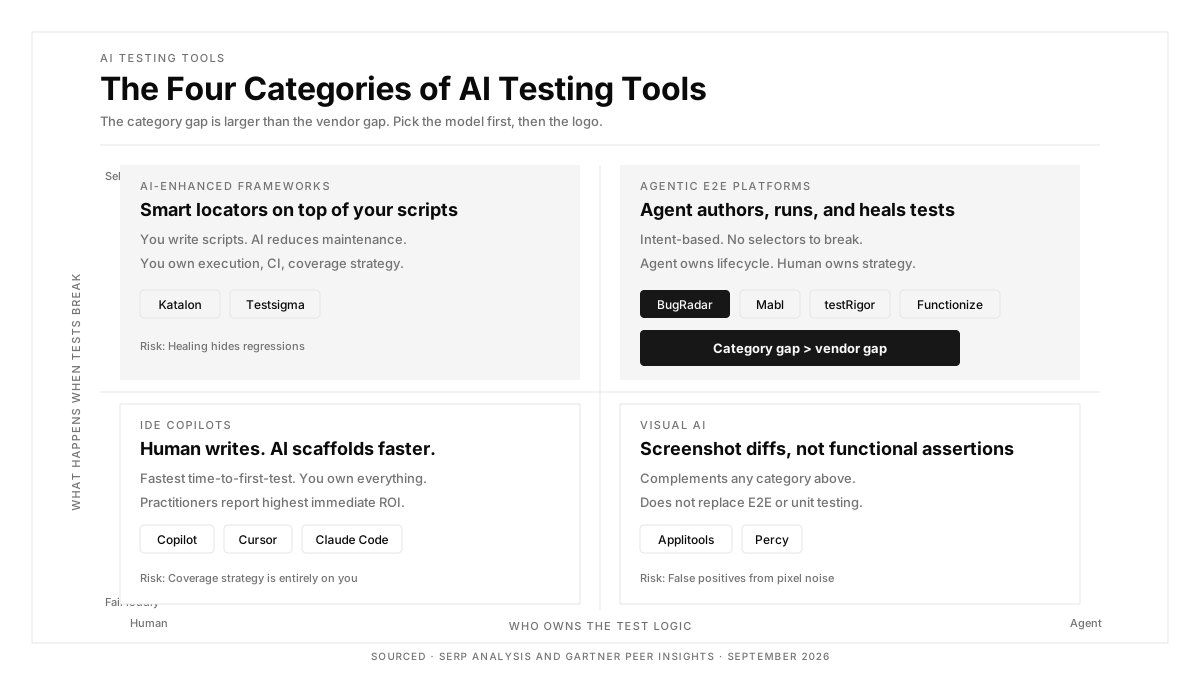
- Agentic platforms, IDE copilots, visual AI, and AI-enhanced frameworks solve different testing problems. Picking the wrong category wastes more time than picking the wrong vendor inside the right one.
- Gartner published its first Magic Quadrant for AI-augmented software testing tools and projects 70 percent enterprise adoption by 2028, up from roughly 20 percent in early 2025, per Gartner Peer Insights.
- Practitioners on Reddit consistently report IDE copilots (Cursor, Copilot, Claude Code) as the fastest ROI because they plug into workflows teams already run.
- Self-healing sounds solved until the tool heals onto the wrong element and the test passes while validating nothing. Every agentic platform carries this failure mode.
- BugRadar operates in the agentic category as an AI E2E testing agent that writes intent-based flows across iOS, Android, and web and self-heals when the UI changes.
Which AI testing tools are teams actually using in 2026?
| Tool | Category | Best For | Pricing |
|---|---|---|---|
| BugRadar | Agentic E2E | Teams shipping iOS, Android, and web who want self-healing flows on every PR | Contact for pricing |
| Mabl | Agentic web | Codeless web regression with visual change detection | From ~$4,000/yr |
| testRigor | Agentic cross-platform | Non-technical teams writing tests in plain English | From $300/mo |
| QA Wolf | Managed service | Teams that want a vendor to own test creation and maintenance end to end | Contact for pricing |
| GitHub Copilot | IDE copilot | Developers wanting inline test suggestions inside their editor | $10/mo individual |
| Cursor | IDE copilot | Engineers who want full-project context for generating tests | Free tier; Pro $20/mo |
| Claude Code | IDE copilot | Teams wanting multi-file test generation with Claude models | $100–200/mo |
| Applitools | Visual AI | Teams adding pixel-level visual regression to existing suites | From $969/mo |
| Katalon | AI-enhanced framework | Mixed-skill teams needing web, mobile, API, and desktop in one IDE | Free tier; paid plans |
| BrowserStack | Cloud + AI agents | Enterprise teams needing real devices with AI test generation on top | From $225/mo |
Agentic test platforms
These tools generate and maintain tests autonomously. You describe what to test in natural language or through a recorder. The agent handles creation, execution, and maintenance when the UI changes. The shared tradeoff: agent runs are slower per step than a pinned selector, and non-deterministic execution can mask regressions if the self-healing logic anchors to the wrong element.
BugRadar: best for cross-platform E2E
Key features:
- Generates intent-based E2E flows from plain-English descriptions, not CSS selectors
- Runs natively on iOS, Android, and web from a single flow definition
- Self-heals when UI changes between builds instead of failing on stale locators
- Posts session replay to every PR via CI/CD integration
- Runs on real devices in the cloud, catching regressions that simulators miss
Where it wins: The core problem for teams shipping all three platforms is maintenance multiplication. One UI change forces selector fixes across three separate test suites. When Airbnb migrated 3,500 React test files across frameworks, engineers on r/ExperiencedDevs estimated 1.5 years of manual work. That is the maintenance scale that builds up when you own separate suites per platform. BugRadar eliminates that multiplication with a single self-healing flow that covers all three surfaces from one definition. Intent-based means the agent tests what the user does, not what the developer thinks the user does.
Where it falls short: Does not run unit tests, API contract tests, or pixel-level visual diffs. For web-only teams with an engineer who already owns a Playwright suite, Playwright is simpler and costs nothing. The Gobi Maps case study shows where the shift makes sense and where it does not.
Mabl: best codeless web regression
Key features:
- Browser-based test recorder with AI-stabilized locators
- Auto-healing when UI elements move or get renamed without human intervention
- Built-in visual change detection that catches layout regressions assertion-based tools miss
- Strong CI/CD integrations for web regression testing
Where it wins: Mabl has been in market longer than most AI testing tools, and the maturity shows in its integration ecosystem and reliability. A practitioner on r/QualityAssurance described the practical impact: AI in their workflow "saved me lots of time once I got good agents and codebase, I would say 50 percent." For QA teams that do not write TypeScript, Mabl removes the authoring barrier without sacrificing maintainability. The visual change detection also catches UI regressions that assertion-based tools miss entirely, like shifted layouts and broken responsive designs.
Where it falls short: Web only. No native mobile support. Pricing starts around $4,000 per year, which prices out small teams. You trade version-control reviewability for ease of authoring. If your team needs mobile coverage, Mabl handles only the web layer.
testRigor: best for non-technical teams
Key features:
- Tests written in plain English across web, mobile, and API surfaces
- No selectors, no code, no page objects required
- QA analysts, product managers, and manual testers can author automated tests directly
- Cross-platform execution from a single test definition
Where it wins: testRigor removes the coding barrier entirely. Teams without SDETs build automation coverage without hiring engineers or learning a framework. Tests read like acceptance criteria, which means product managers can verify what the test actually validates and contribute test cases directly.
Where it falls short: Plain-English tests are harder to debug when scenarios get complex. Custom logic and conditional flows are limited compared to code-first tools. Starting at $300 per month, it is more expensive than open-source alternatives for teams that have the engineering skills to use them. ACCELQ and Functionize offer similar codeless approaches with different strengths.
QA Wolf: best managed testing service
Key features:
- Generates deterministic Playwright and Appium code from prompts
- Vendor owns test creation, maintenance, and triage end to end
- Includes its own iOS device farm for mobile coverage
- Human QA engineers supplement the AI for edge cases and complex flows
Where it wins: QA Wolf is less a tool and more an outsourced QA function. For teams that want regression coverage without hiring a QA team, it removes the staffing bottleneck entirely. The generated code is Playwright under the hood, so you get deterministic execution without the non-determinism risks of agent-based tools.
Where it falls short: You do not own the tests. The vendor relationship means switching costs are high, and you have limited visibility into test logic decisions. Pricing is enterprise-level and typically requires a contract. For teams that want control over their test architecture and coverage strategy, a managed service trades autonomy for convenience.
IDE copilots
These generate test code inside your editor. You write the production code; the copilot suggests the test. Practitioners consistently report them as the most reliable AI testing investment because they integrate into existing workflows rather than replacing them. The shared tradeoff: coverage strategy, maintenance, and CI infrastructure remain entirely yours.
GitHub Copilot: best for inline test suggestions
Key features:
- Context-aware code completion tuned to surrounding test patterns
- Works in any test framework: Jest, pytest, JUnit, XCTest, Espresso
- Follows conventions already established in the repository
- Available at $10 per month individual, $19 per month business
Where it wins: The lowest friction entry point for AI-assisted testing. GitHub Copilot lives inside the editor you already use and generates boilerplate test code from the surrounding context. For scaffolding standard assertions and test structure, it saves real time on the repetitive parts of test authoring.
Where it falls short: A veteran QA engineer on r/QualityAssurance was candid: "I hit ESC more often than I use Copilot suggestions. The chat feature is abysmal unless you're asking basic stuff." Copilot generates from the code, so it tests what the code does, not what the code should do. It produces individual test files, not coordinated regression suites.
Cursor: best for project-level test context
Key features:
- Full-file and project-level context for generating test boilerplate
- AI-native editor built around code generation workflows
- Supports multi-file edits and refactoring across test suites
- Free tier with limited completions; Pro at $20 per month
Where it wins: A QA engineer on r/QualityAssurance noted their only real go-tos are "Cursor plus Anthropic for coding and querying the repos." Another practitioner on r/QualityAssurance described using Cursor with Playwright MCP to "cover the complete application in a few days" with zero prior coding experience. The project-wide context window is what separates Cursor from Copilot's per-file suggestions.
Where it falls short: Still an editor, not a test platform. You own execution, CI, data setup, and coverage strategy. For teams without existing test infrastructure, Cursor generates code but does not run it, maintain it, or tell you what to test next.
Claude Code: best for multi-file test generation
Key features:
- Git-aware workflows with multi-file edit and planning capabilities
- Deep codebase understanding for generating tests that match existing patterns
- Supports complex refactoring across entire test suites
- Available at $100-200 per month
Where it wins: A DevOps engineer on r/devops described the first encounter: it "planned and worked with hundreds of files, found what it needs to do, and did it first try." Claude Code operates at the codebase level rather than the file level, which makes it better suited for generating coordinated test suites that span multiple modules than inline copilots.
Where it falls short: Highest price point among IDE copilots. Overkill for single-file test generation where Copilot or Cursor does the job. Like all copilots, it generates code from existing patterns rather than from an understanding of business requirements.
Visual AI testing
Applitools: best for visual regression
Key features:
- Visual AI that distinguishes meaningful UI changes from rendering noise
- Integrates as a layer on top of Selenium, Playwright, Cypress, or Appium suites
- Baseline management with approval workflows for intentional design changes
- Cross-browser visual validation without writing pixel-comparison code
Where it wins: Applitools catches the regressions that assertion-based tools miss entirely: shifted layouts, broken responsive designs, font rendering differences across browsers, and spacing inconsistencies that no selector can detect. It complements any functional testing tool rather than replacing one. For teams already running Playwright or Cypress, adding Applitools takes a few lines of SDK integration.
Where it falls short: Visual regression only. Does not test functionality, user flows, or API behavior. Starting at $969 per month, it is the most expensive single-purpose tool on this list. Percy (now part of BrowserStack) and Chromatic offer lower-cost alternatives for teams with simpler visual needs.
AI-enhanced test platforms
Katalon: best for mixed-skill teams
Key features:
- AI-powered test generation across web, mobile, API, and desktop surfaces
- Both codeless recorder and scripting support for teams with varied skill levels
- TrueTest autonomous generation from user flow analysis
- Free tier available for small teams to evaluate
Where it wins: Katalon has the widest surface coverage of any single tool on this list: web, mobile, API, and desktop. QA analysts use the recorder while SDETs write scripts, both working in the same platform. The free tier is generous enough for evaluation without procurement overhead.
Where it falls short: All-in-one means not best-in-class at any single surface. Playwright outperforms it for web automation. Appium has a deeper mobile ecosystem. For teams that need depth in one area rather than breadth across many, a specialized tool delivers more.
BrowserStack: best cloud infrastructure with AI agents
Key features:
- 3,500+ real browsers, operating systems, and physical mobile devices
- AI agents for self-healing, visual review, and accessibility detection
- Execution infrastructure that pairs with any testing tool or framework
- Parallel execution at enterprise scale
Where it wins: BrowserStack is primarily device infrastructure, not a test authoring tool. The AI agents are a newer layer on top. For teams that need to run existing Playwright, Appium, or BugRadar tests across dozens of real devices, BrowserStack provides the execution scale. Real devices catch failures simulators miss: camera access, GPS behavior, biometric prompts, push notification handling, and memory pressure on lower-end hardware.
Where it falls short: Charges for execution capacity, not test creation. If your suite is five scripts on two devices, the cloud lab adds cost without value. The AI agent features are newer and less mature than dedicated agentic platforms like Mabl or BugRadar. LambdaTest (from $15/mo) and Sauce Labs offer alternatives at different price points.
Which category fits your team?
Three questions cut the field from ten tools to two or three.
Who writes the tests? If developers own testing, an IDE copilot (Copilot, Cursor, Claude Code) plus a framework like Playwright gives maximum control. If your team has no dedicated test engineers, an agentic platform (BugRadar, Mabl, testRigor) removes the bottleneck. A senior QA lead on r/softwaretesting framed the core risk of over-relying on AI: "You basically have an overeager intern on its perpetual first day of work. They are so eager, they will do work for you even if it doesn't make sense." The AI is a tool. It still requires human judgment about what to test.
What platforms do you ship to? Web-only teams have the widest selection. Teams shipping iOS, Android, and web narrow to BugRadar, testRigor, or a multi-tool stack (Playwright plus Appium plus a cloud lab). Mobile is where most AI testing tools fall short. A QA engineer on r/QualityAssurance described the shift: "manual mobile app testing seems to take longer. Every sprint, same feature scope." The debugging surface multiplies with app state, OS version, device permissions, and cloud device slowness.
Do you want to own the tests? IDE copilots and frameworks give full ownership and version control. Agentic platforms vary: BugRadar and Mabl let you own the flows, while QA Wolf owns them for you as a managed service. The ownership model affects switching costs, auditability, and how much your team actually learns about what the tests cover.
Conclusion
The best AI testing tool depends on what you need the AI to do: generate and maintain tests autonomously, suggest code in your editor, compare screenshots, or scale your device coverage. Start by picking the category. Then pick the vendor. And treat every AI-generated test as a draft until a human confirms the assertions match the business logic.
FAQ
What is the best AI testing tool for beginners?
testRigor or Katalon. Both support plain-English or low-code test authoring without requiring Playwright or Selenium expertise. For beginners who want to learn test code while getting AI help, Cursor scaffolds tests inside the editor with explanations.
What is the best free AI testing tool?
GitHub Copilot offers a free tier for individual developers. Katalon has a free tier for small teams. Cursor has a free tier with limited AI completions. For visual regression, Percy offers a free tier through BrowserStack.
Can AI testing tools replace manual testers?
Not for exploratory testing, usability judgment, or domain-specific validation. AI tools accelerate regression coverage and reduce maintenance on stable flows. The Gobi Maps case study shows how teams use BugRadar for the regression layer while manual testers focus on new features.
How much do AI testing tools cost?
Ranges from free (Copilot, Katalon free tier) to enterprise pricing (Applitools from $969/mo, QA Wolf and Mabl at custom quotes). Agentic platforms price by test volume or flow count. IDE copilots price per seat.
Do AI testing tools work with Playwright and Cypress?
Most IDE copilots generate Playwright or Cypress code directly. Applitools and Percy integrate via SDK. Agentic platforms like BugRadar and testRigor replace the framework rather than extending it, running their own execution engine.
What is self-healing in AI testing tools?
The tool automatically updates locators or test steps when the UI changes. Quality varies widely. Basic self-healing retries alternative CSS selectors. Advanced self-healing (like BugRadar's intent-based approach) re-anchors to the element matching the original user intent regardless of selector changes.
Is AI testing reliable enough for CI/CD pipelines?
For regression suites on stable flows, yes. For edge cases and complex multi-step workflows, AI-generated tests require human validation before gating deployments. The reliable pattern: AI generates, a human reviews assertions, then promote to CI gates.
Which AI testing tool works best for mobile apps?
BugRadar runs one intent-based flow across iOS, Android, and web. testRigor supports cross-platform via plain English. QA Wolf generates Appium scripts for native mobile. Most other tools require per-platform test definitions for mobile coverage.