Manual Testing vs AI-Automated Testing: The Real Cost Comparison for Mobile Teams
Compare the real costs of manual, traditional, and AI-automated mobile testing, including QA effort, maintenance, device infrastructure, break-even timelines, and how BugRadar can reduce the ongoing testing cost.
- Written by
- Yuvan Sundrani
- Read time
- 13 min read
- Published

TL;DR
Manual mobile testing scales linearly with team size and release cadence. A single QA engineer covers 50 test cases per two-week cycle at roughly $17,000 to $26,000 a year. Scale that to a 500-test-case suite on a weekly release cadence and the annual bill lands in the $324,000 to $432,000 range before hidden costs.
AI-automated testing inverts the shape of the bill. Cost is high in month one, then flat regardless of test-case volume. Most mobile teams reach break-even between months 4 and 8, and the crossover only accelerates as release cadence increases.
BugRadar is the AI-automated option for mobile teams that want the crossover without the traditional automation setup tax. Natural-language flows and a real-device cloud replace both the manual QA rotation and the classic Selenium-style scripting and maintenance stack.
How much does manual mobile testing actually cost in 2026?
The direct cost of manual mobile testing is a function of three variables: test-case volume, release cadence, and the fully loaded hourly rate of a QA engineer.
Industry averages published in the 2026 ARDURA Consulting cost breakdown put the fully loaded rate for a mid-market QA engineer at $45 per hour. That rate lines up with the base-plus-benefits calculation for a $65,000 to $85,000 junior QA salary and the recruitment overhead most teams add on top.
Direct annual manual-testing cost by suite size and cadence, using the ARDURA figures as the anchor:
| Suite Size | QA Hours per Cycle | Bi-Weekly Annual | Weekly Annual |
|---|---|---|---|
| Small (50 Test Cases) | 16 to 24 | $17,280 to $25,920 | $34,560 to $51,840 |
| Medium (200 Test Cases) | 60 to 80 | $64,800 to $86,400 | $129,600 to $172,800 |
| Large (500+ Test Cases) | 150 to 200 | $162,000 to $216,000 | $324,000 to $432,000 |
Those numbers are the visible line item. The hidden ones almost always add another 20 to 40 percent on top before the year ends.
What are the hidden costs of manual mobile testing?
Every production release ships a small number of bugs the manual suite did not catch. Industry survey data from the ARDURA breakdown and the same figures cited in the Ranger 2026 cost analysis both put the manual-testing human error rate at 5 to 15 percent per cycle.
That is the fraction of defects a fresh tester misses. It climbs after the third consecutive regression cycle because attention fades.
A bug that ships to production costs 5 to 10 times more to fix than the same bug caught during testing. That multiplier is the largest hidden line item in most manual QA budgets.
Documentation maintenance eats another 15 to 20 percent of tester time. Every test case updated as the UI changes needs a rewritten step, a fresh screenshot, and a re-verification run. Compounded across a 500-case suite, that overhead alone matches the annual salary of a junior tester.
Knowledge concentration is the least measured cost and the hardest to recover from. When the senior QA engineer who knows which edge cases to poke leaves, the institutional map of the suite leaves with them.
How much does AI-automated mobile testing cost?
AI-automated testing has an inverted cost shape. The heavy spend is upfront. The recurring spend is close to flat.
The Ranger 2026 cost analysis, which aggregated published pricing from three AI-native testing platforms, put the first-year total for an AI-native setup at $160,000 to $320,000. That figure includes licensing, integration engineering time, and team training.
The Ardura Consulting breakdown lands on a similar range for a medium-project initial setup: $46,500 to $83,000, growing to $103,000 to $198,000 for a large project.
The ongoing cost after setup is the line that surprises finance teams. Ranger's number for a full AI-native platform holds steady at $120,000 to $240,000 per year regardless of test-case volume, because AI-native tools do not require a proportional headcount increase to expand coverage.
The Ardura ongoing monthly numbers back the same shape: $4,000 to $8,500 for a small project, $22,000 to $48,000 for a large one. Test-execution cost per run is effectively zero because the runtime is measured in minutes, not tester-days.
When does AI-automated testing become cheaper than manual testing for mobile?
The break-even question is the one buyers actually care about, and it has a specific answer.
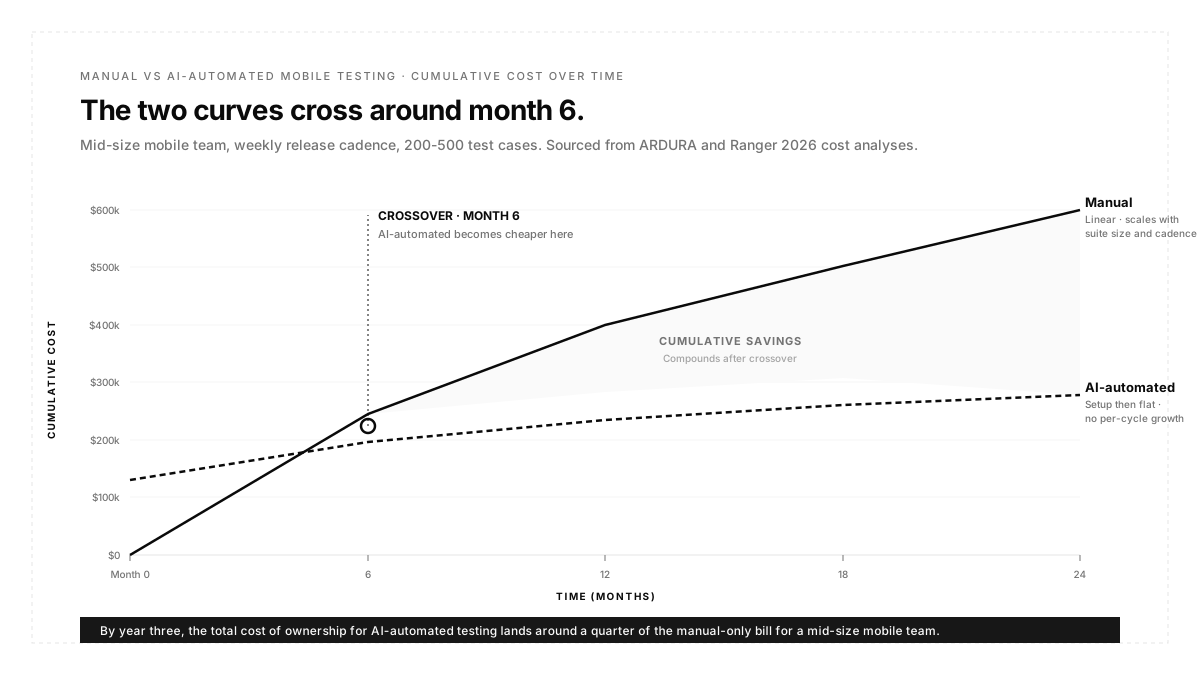
For a mobile team on a weekly release cadence with a suite in the 200 to 500 test-case range, the crossover point sits between month 4 and month 8 in every one of the top-ranking 2026 analyses.
The Ranger data puts break-even at month 4 for a large team, month 8 for a mid-size team. The Ardura crossover analysis puts the medium-project break-even in the same window.
Release cadence is the single variable that moves the crossover most. A team on a monthly release cadence pushes break-even out to month 12 or later. A team on continuous deployment reaches break-even inside three months.
After the crossover, the two cost lines diverge sharply. Manual continues to climb at its linear rate. AI-automated stays flat. Cumulative savings compound quarter over quarter, and by year three the delta is typically 3 to 4x in favor of AI-automated for a mid-size team.
What formula should mobile teams use to calculate their own cost?
The reader-computable version of the break-even math has four inputs and one output.
Inputs:
- Test-case count (suite size).
- QA hours per cycle (16 to 24 for a small suite, 150 to 200 for a large suite, per the ARDURA table).
- Cycles per year (26 for biweekly, 52 for weekly, 250+ for continuous deployment).
- Fully loaded QA hourly rate ($45 is the 2026 mid-market anchor; $65 to $95 for US-based teams in high-cost metros).
Output: Direct annual manual cost = QA hours per cycle × cycles per year × hourly rate.
Add 20 to 40 per cent on top of that for the hidden-cost stack (production-bug multiplier, documentation overhead, knowledge concentration risk).
Compare the resulting number against the AI-automated bands from the previous sections. The intersection point is the crossover. The number of months to crossover equals the AI-automated first-year setup cost divided by the monthly delta between the two.
Why does the traditional automation option not close the gap on its own?
The math above compares manual to AI-automated. The middle option in the industry has historically been traditional scripted automation using Selenium, Appium, or the classic Espresso/XCUITest stack. That option carries its own cost structure worth naming.
Traditional automation lowers per-cycle execution cost but adds a maintenance tax. Every UI change breaks the selector-bound tests, and the industry-standard estimate published in the ARDURA breakdown puts selector maintenance at 30 to 50 percent of the automation team's engineering time.
The Ardura three-year total-cost-of-ownership figure for traditional automation lands at $1.49 million to $1.70 million for a medium project. That is cheaper than the $4.09 million to $4.13 million manual number. It is materially more expensive than the AI-native band of $400,000 to $800,000.
Traditional automation was a step forward when the alternative was pure manual. It is a step sideways when the alternative is AI-automated testing with self-healing execution.
What does an AI-automated mobile testing stack actually replace?
The line items that leave the budget when a mobile team moves from manual to AI-automated are specific and enumerable.
The biweekly regression cycle stops consuming 60 to 200 QA hours. The BugRadar automations feature runs the same flows on a schedule and reports results without a person in the loop.
The device fleet stops being a separate contract. Flows execute against a real-device cloud documented at docs.usebugradar.com/real-device-testing, which folds the grid cost into the platform bill rather than a second procurement line.
The selector-maintenance line goes to zero. Flows are written in natural language and executed by an agent that reads the screen visually, which removes the 30 to 50 per cent of engineering time that traditional automation loses to selector rewrites.
The CI-side integration cost stops being a per-cycle line. The BugRadar GitHub bot runs the relevant flows on every pull request and returns results with videos in a PR comment, removing the manual triage step.
How does BugRadar compare to the AI-automated cost bands the industry publishes?
BugRadar sits inside the AI-native band the top-ranking 2026 cost analyses use as the reference. The first-year total, the ongoing steady-state cost, and the flat-scaling shape all match the numbers Ranger and Ardura publish as category norms.
The two properties that shift BugRadar's position inside that band are worth naming.
Natural-language flow authoring removes the two-to-four-week team training line item most AI-native tools still carry, because non-engineers can author flows on day one. The code-managed flows option removes the governance gap most codeless SaaS platforms leave open, so the flows can live in a Git repository and go through code review.
The buying decision that matters is not BugRadar against another AI-native platform. It is the decision to leave the manual-only or manual-plus-Selenium mixed model behind, which is the decision the crossover math already answered.
Conclusion
Manual mobile testing has a linear cost shape that scales with test-case volume, release cadence, and QA salary bands. AI-automated testing has an inverted cost shape that starts high, then flattens.
The two cost curves cross for most mobile teams between month 4 and month 8 on a weekly release cadence. After the crossover, the delta compounds quarter over quarter, and the three-year total cost of ownership for AI-automated lands at roughly a quarter of the manual-only bill for a mid-size team.
The path that ages best is to model the specific numbers using the formula above, run the crossover date against the team's current release cadence, and route the highest-cycle-count flows to AI-automated first. That is the shape the category is taking, and it is the shape BugRadar was built for.